 Skip to content






Master's Degree in Software Engineering
andArtificial Intelligence (MISIA)
The official master's program for developers and engineers who want to lead AI projects, master cloud development, and earn certifications from Amazon and Google.
Official British degree (UWTSD) in Zaragoza and available online from any city in Spain.
Language
Spanish / English
Next start
Sept. 2026
official title
RUCT – 8000101
Format
Online or Blended Learning
Duration
9 academic months*
Credits
90 ECTS
* Duration of the module phase, excluding the final project
Would you like more information?
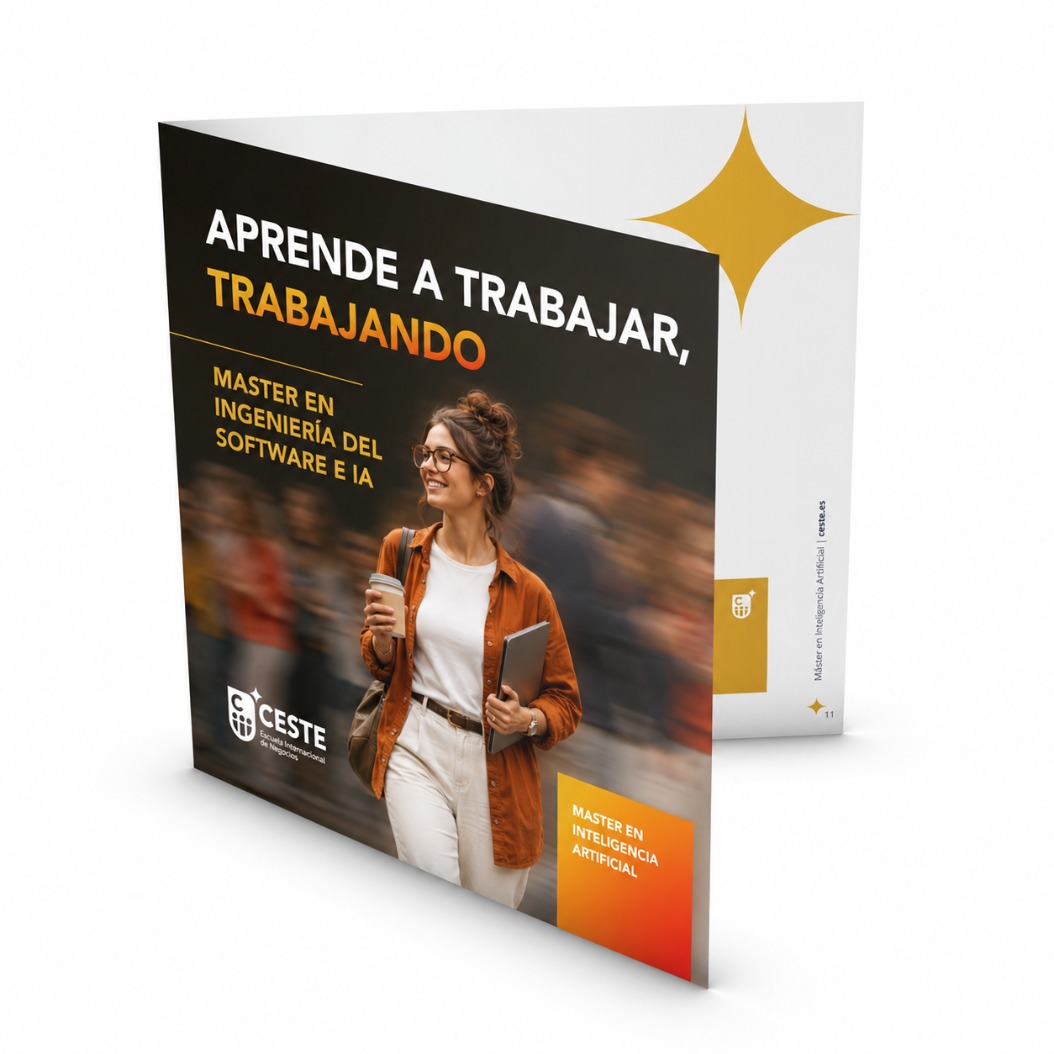
Get the brochure with no obligation
Official Master's Degree in Software Engineering and AI
The Master's in Software Engineering with AI that is most focused on the real world
CESTE’s Master’s in Software Engineering and Artificial Intelligence is the program for developers, engineers, and computer scientists who want to make the leap into AI projects—not just to use AI as a tool, but to design it. It is an accredited master’s degree in software engineering that combines a technical foundation in advanced development with machine learning, cloud engineering, cybersecurity, and DevOps— exactly what tech companies are looking for in the market right now.
The degree is an official British degree from the University of Wales Trinity Saint David (UWTSD), recognized within the European Higher Education Area and registered with the RUCT under code 8000101. It is not a general AI program for executives; rather, it is a master’s degree in AI for developers that includes real code, projects using real datasets, and certifications from Amazon and Google that are valued by employers.
Why Choose the MISIA DE CESTE?
What sets this master's degree in software engineering apart from any other
🤖
You don't learn how to use AI—you learn how to build it
You'll design machine learning models, implement generative AI solutions using HuggingFace, and work with GitHub, Claude, Copilot, and ChatGPT as production tools.
☁️
Graduate a year early
3 years compared to the 4 years required for a Spanish computer engineering degree. In an industry that values early experience, you gain a full year to enter the tech job market, earn your certification, and start contributing to the workforce while others are still in school.
🎓
Official British title registered in the RUCT
The BAC is part of the British university system. It’s the pathway to studying computer science without taking the PAU: admission is based on your background and motivation. And if you don’t have the PAU or have a low score, the Foundation program prepares you to successfully transition into the program.
⚡
Faculty members who are actively working in the industry
Cloud architects, DevOps specialists, data governance experts, and AI consultants. 100% of the faculty are currently working at companies in the technology sector.
🔐
Integrated Cybersecurity, Governance, and Ethics
Advanced software developmenttoday requires a solid graspofdata security from the very first sprint. At MISIA, cybersecurity is a standalone module, not just a footnote.
🌐
Online from any city in Spain
Classes are live, in the afternoons (GMT+1), with recordings available. If you prefer to complete the master's program with in-person modules in Zaragoza, a blended learning option is available.
Student Profile
Is this the AI master's program you're looking for?
The MISIA program is designed for technical professionals who already know how to program and want to take the next step: leading the development of AI-powered solutions in business environments. It is not an introductory master’s program in artificial intelligence for non-technical students. It is a master’s program in software engineering with AI for those who already have a foundation and want to take their skills further.
You have a degree in computer science, telecommunications, or engineering and want to specialize in AI
You have a technical background and are looking for a master’s degree in software engineering that will put you at the cutting edge of the industry.
Are you an active developer looking to integrate AI into your projects in a structured way?
AI is no longer the future—it’s the present. You need a master’s program in AI for developers that teaches you how to implement ML, GenAI, and cloud architectures without taking time off from work. The MISIA program offers evening classes to help you balance your studies with your career.
Are you a BAC graduate or do you hold another degree in computing and want to continue your studies at CESTE
? If you have completed the Bachelor in Applied Computing, the MISIA is the natural next step, with exclusive financial terms for alumni.
Are you looking for an online or blended-learning master’s degree in software engineering outside of Madrid or Barcelona
Whether you’re in Bilbao, Valencia, Seville, or any other Spanish city, MISIA’s blended-learning program offers the same live classes, the same projects, and the same official degree. There’s no need to move.
Professional skills
Skills Covered in the Official Master's Degree in AI and Software Engineering
Advanced Software Engineering
You will design, build, and deploy complex applications using agile methodologies, DevOps, and CI/CD. You will learn how to make architectural decisions in cloud environments and work on high-performance technical teams.
Applied Artificial Intelligence
You'll implement machine learning, deep learning, and generative AI models to address real-world business problems. Not only will you learn how to use AI tools, but you'll also understand how they're built and be able to design your own.
Cloud Engineering and DevOps
You will manage scalable infrastructure on AWS and Google Cloud, automate deployment pipelines, and implement security-by-design practices. These skills are directly validated by the Amazon and Google certifications included in the program.
Data Security and Governance
You will apply regulatory compliance frameworks, protect data in distributed environments, and make technical decisions based on ethical and privacy considerations. This is a skill that companies demand from day one, and few programs cover it as thoroughly as MISIA does.
Degrees and Certifications
An official degree and certifications that open doors in the industry
Upon completing the MISIA program, you will earn anMSc in Software Engineering and Artificial Intelligencefrom UWTSD, anofficial master’s degree in artificial intelligencerecognized in Spain, the European Union, and the United Kingdom. In addition, the program includes preparation for Amazon and Google certifications, which companies verify directly during the hiring process.
Officially Recognized Degree
MSc in Software Engineering and Artificial Intelligence. Recognized in Spain, the European Union, and the United Kingdom, with access to a doctoral program.

Amazon AWS Certifications
Specializations in Machine Learning Engineering, AI, and Data Analysis. These are integrated into the program; they are not optional external courses.
Google TensorFlow Certification
Official Google certification. Validate your expertise in deploying deep learning models in production environments.
Syllabus and Modules
Curriculum for the Master's Degree in Software Engineering and Artificial Intelligence
The program is divided into two parts. Part 1 is the coursework phase; it lasts 9 months and is organized into six modules that comprehensively cover agile development and DevOps, machine learning, artificial intelligence, cloud engineering, data security, and research. Part 2 is the Master’s Thesis, a non-coursework phase that can take up to one year to complete. Click on any module to view its full content.
- Credits
- 90 ECTS
- Degree
- Master's Degree in Software Engineering and ArtificialIntelligence—Official British degree from UWTSD
- RUCT Code
- 8000101
Part 1 · Module Instruction Phase
9 months, afternoon schedule
Six training modules
1
Agile Software Development and DevOps
Agile methodologies, DevOps culture, CI/CD pipelines, and infrastructure as code.
8 items
Introduction to Agile Development
Principles, values, Scrum, Kanban, and agile methodologies.
Fundamentals of DevOps
Life Cycle, Culture, and Collaboration.
Configuring CI/CD Pipelines
Tools and continuous deployment.
Team Collaboration Tools
Version control systems and platforms for distributed teams.
Adaptive Development Practices
Adapting to Change and Agile Management Tools.
Automation and Infrastructure as Code
Tools such as Jenkins and Terraform.
Quality Assurance and Testing in DevOps
Automated and continuous testing.
Security Integration
Security in the development cycle and secure coding.
2
Applications of machine learning
Applied Machine Learning: From Problem Formulation to Model Deployment.
8 items
Introduction to Machine Learning
Data Types, Basic Algorithms, and Applications.
Problem Identification and Formulation
Problems suitable for ML and clear objectives.
Data Preprocessing
Data cleaning, handling of missing values, and standardization.
Model Selection and Evaluation
Popular algorithms, evaluation metrics, and selection.
Feature Engineering Techniques
Screening, extraction, and size reduction.
Model Deployment and Integration
Deployment strategies and real-world applications.
Ethical Considerations
Bias, Equity, and Ethical Guidelines in Machine Learning.
Advanced Applications
Natural Language Processing and Computer Vision.
3
Artificial Intelligence
Generative AI and foundational algorithms, from reasoning to natural language and computer vision.
8 items
Introduction to AI
History, evolution, applications, and use cases.
Troubleshooting with AI
Search, heuristic, and optimization algorithms.
Representation and Reasoning in Knowledge
Representation Techniques and Logic.
Machine Learning in AI
Supervised and unsupervised learning and integration with AI.
Natural Language Processing
Text analysis and generation.
Computer Vision
Image processing and generation.
Ethical and Social Implications
Bias, Equity, and Ethical Guidelines in AI.
AI Project Development
Practical applications and teamwork.
4
Cloud Engineering Principles and Practices
Cloud Engineering with AWS and Google Cloud: From Design to Deployment with Docker and Kubernetes.
8 items
Introduction to Cloud Computing
Service and Deployment Models.
Cloud Infrastructure Design
Scalability, Resilience, and Case Studies.
Cloud Services and Solutions
Major suppliers and practical applications.
Deployment and Orchestration
Containers (Docker) and tools such as Kubernetes.
Security and Compliance
Safety Standards and Regulations.
Monitoring and Optimization
Optimization tools and strategies.
Integration with DevOps
DevOps Practices and CI/CD Pipelines in the Cloud.
Hands-on projects
Cloud solutions and collaborative problem-solving.
5
Data security, governance, and compliance
Threats, regulation, access control, encryption, and incident response.
8 items
Fundamentals of Data Security
Threat Models and Risk Analysis.
Data Governance and Management
Principles of Governance and Data Quality.
Regulatory Compliance
Industry-specific regulations and standards.
Risk Assessment and Mitigation
Strategies for identifying and mitigating risks.
Security Measures for Storage and Transmission
Encryption practices and protocols.
Access Control and Authentication
Policies and Multifactor Authentication.
Encryption Techniques
Symmetric and asymmetric methods.
Incident Response and Recovery
Continuity Planning and Strategies.
6
Research and Professional Development
Research methodology, data analysis, technical writing, and presentation.
8 items
Introduction to Research in Computer Science
Research Process and Problem Definition.
Literature Review Techniques
Literature search, synthesis, and evaluation.
Experimental Design and Methodology
Hypothesis Formulation and Experimental Design.
Data Analysis
Statistical Methods and Data Visualization.
Technical Writing and Documentation
Technical reports and citations.
Effective Presentation Skills
Presenting Complex Ideas.
Research Ethics
Ethical Considerations and Responsible Conduct.
Research Project Management
Planning, coordination, and teamwork.
Technologies You'll Work With
- Generative AI (GenAI) and Applied LLMs
- HuggingFace
- Kaggle
- GitHub
- AWS (Amazon Web Services)
- Google Cloud
- GitHub Copilot
- ChatGPT in Production
- Google TensorFlow
- MLOps
- Scrum
- CI/CD
- Docker
- Kubernetes
Part 2 · Master's Thesis
Non-instructional period, up to 1 year
You will prepare, submit, and present your Master’s Thesis with the guidance of an academic advisor over a period of no more than one year. The thesis addresses a real-world software engineering problem involving artificial intelligence, to demonstrate that you can apply what you have learned in a production environment.
- Academic advisor throughout the project
- Focused on a real-world software engineering problem involving AI
- Project Submission and Final Presentation
Afternoon schedule that fits with your current job. The sessions are recorded.
Degree
What degree do you earn upon graduation?
Upon completion of your training, you will receive the following certification.

Official British title
Master's Degree in Software Engineering and Artificial Intelligence
Official British degree awarded by the University of Wales Trinity Saint David (UWTSD). RUCT code 8000101. 90 ECTS credits.
Internships
CESTE Professional Development Service
The top students are selected by CESTE's Professional Development Service for professional internships, with high rates of employment upon completion.
And if you want to go even further, the master's program provides a pathway to doctoral studies.
The program is subject to change.
Employability and Career Opportunities
Where do MISIA graduates work?
TheAI software engineeringsector is experiencing the fastest growth in job demand across Europe. Professionals who know how to implement AI in production environments enjoy full employment. These are the roles that MISIA graduates go on to fill.
Artificial Intelligence Engineer
Designs and implements ML models, GenAI systems, and AI pipelines in enterprise production environments.
Advanced Software Developer
Lead thedevelopment of advanced softwarewith AI integration, agile sprints, and cloud-native architectures.
Machine Learning Specialist
Build, train, and deploy predictive and generative models using TensorFlow, PyTorch, HuggingFace, and MLOps in production.
Cloud Solutions Architect
Design scalable infrastructure on AWS and Google Cloud to deploy AI systems with high availability and security.
Technology Project Manager
Coordinates technical teams on digital transformation projects and the implementation of AI-based solutions.
Digital Transformation Consultant
She advises companies on the strategic adoption of AI, systems architecture, and process optimization using artificial intelligence.
89%
Employment rates in the 6 months following graduation (UWTSD Graduate Outcomes Survey)
100%
Job placement of CESTE graduates in their professional field
300+
Companies in the CESTE Business Club with agreements for internships and employment
+20K
Students trained in our classrooms with a curriculum geared toward the professional world.
CESTE Student Reviews
What our students say
Find out what our students and faculty who have already completed their training at CESTE have to say about this high-quality, rigorous master’s program.
Who better than them to tell us about their experience at the school, share their thoughts on the quality of each course in the cybersecurity master’s program, describe the classroom dynamics and the technology used, and offer recommendations for you as you prepare to start the new program soon.
MISIA Student · Class of 2026
🔴 Hear about the experience firsthand
Natalia Sisamón
“When I finished my degree in mathematics, all my professors agreed on one thing: the world of data was booming. By that time, I had already started working at Nikon, so I decided to pursue this master’s degree because it offered a very comprehensive curriculum and also allowed me to balance work and school. For me, it’s the perfect combination: learning new skills while applying them in the real world.”
Fernando Blasco
"I work in website design and development, and this master's program has given me the tools to do my job more efficiently, as well as the knowledge I need to offer valuable solutions to our clients."
Diego Marzo
“Having in-depth knowledge of all the technologies that enable us to work with business-oriented data is a very important added value for me. Looking at current job postings, I see that many of the skills acquired in this master’s program are in high demand.”
Admissions Process
How to Apply for a Spot at MISIA
The process is streamlined and guided. All you need is a college degree in computer science, engineering, or a related technical field.
1
Request information
Fill out the form and an advisor will contact you within 24 hours, with no obligation.
2
Profile Interview
A conversation to understand your technical background and help you navigate the program.
3
Documentation
ID card/passport and a college degree in computer science, engineering, or another technical field. 100% online application process.
4
Start: Sept. 2026
Welcome to MISIA. Real-world projects, deployable AI, and certifications that count from day one.
Financial Aid 2026–27
Up to 45% off
Early enrollment discounts. The sooner you reserve your spot, the bigger the discount. These discounts can be combined with alumni, large family, and repeat enrollment discounts. For information on pricing and personalized financing options, speak with your advisor.
45% off
Register by February 28
35% off
Register by April 30
30% off
Register by May 31
25% off
Enroll by July 15
+ discounts
Large Family · Alumni · Buyback
FAQs
Frequently Asked Questions About the Master's in Software Engineering and Artificial Intelligence
We answer the most common questions about CESTE's MISIA
Who is MISIA designed for? Do I need to know how to program?
The MISIA program is designed for candidates with prior technical training: computer engineers, graduates in computing, telecommunications, mathematics, or physics, and active developers with a background in programming. It is not an introductory master’s program in AI for non-technical candidates. A bachelor’s degree in computer science, engineering, or another relevant technical field is required.
Is the MISIA an official master's degree? Is it recognized in Spain and Europe?
Yes. MISIA awards the officialMSc in Software Engineering and Artificial Intelligencedegree from the University of Wales Trinity Saint David (UWTSD), which is recognized within the European Higher Education Area and registered in the RUCT under code 8000101. Thisofficial master’s degree in artificial intelligenceis fully valid for working in the private sector, certifying postgraduate training, and gaining admission to doctoral programs in Spain and abroad.
Can I take the master's degree in software engineering online or through distance learning?
The MISIA program is offered in both fully online and hybrid formats. The fully online format allows you to attend live classes from anywhere in Spain or abroad, with access to recordings. If you’re looking for anonline master’s degree in software engineeringwith an official degree and live classes taught by industry professionals, the MISIA meets both requirements.
What certifications are included in the AI master's program?
The MISIA program includes preparation for professional certifications from Amazon (specializations in Machine Learning Engineering, Artificial Intelligence, and AWS Data Analytics) and Google (TensorFlow certification). These credentials are integrated into the program’s modules (they are not external elective courses) and can be verified directly by employers.
Is it possible to work while pursuing the master's degree?
Yes. Classes are held in the afternoons (GMT+1) so you can balance them with your job. All sessions are recorded and available on the platform. Many MISIA students begin applying what they’ve learned at their current company as early as the first month.
Does the MISIA program lead to a Ph.D.?
Yes. The official MISIA degree (MSc in Software Engineering and Artificial Intelligence, UWTSD) qualifies graduates for doctoral programs in Spain and abroad, both in AI research and in highly specialized roles in the job market.
When is the next session, and how do I reserve a spot?
The next MISIA program begins in September 2026. Space is limited, and spots are filled on a first-come, first-served basis. The sooner you complete your registration, the larger the discount you’ll receive. Fill out the form, and we’ll contact you within 24 hours to explain the entire process.
Faculty
Faculty Members of the Master's Program in Software Engineering and AI
Cloud architects, DevOps specialists, data governance experts, and AI consultants who bring real-world software engineering and artificial intelligence to the classroom. 100% of the faculty are currently working in the tech industry.
CLOUD COMPUTING SECTION
CTO at Apser
Cloud Solutions Architect at Apser
AGILE AND DEVOPS AREA
Computer Engineer (MECES)
IT Instructor | Specializing in Web Development
GOVERNANCE AND SECURITY AREA
Senior Data Scientist
Data Analytics | Data Engineer
RESEARCH AND PERSONAL DEVELOPMENT AREA
Business Unit Director
Director of Software Development at Integra Tecnología
APPLICATIONS OF MACHINE LEARNING AND ARTIFICIAL INTELLIGENCE
Data Architect at Unicaja
Academic Coordination at CESTE
Lead Data Scientist at Decide4AI
Where We Are
CESTE in Zaragoza — A university campus in the heart of Aragon
Earn your Master’s Degree in Software Engineering and Artificial Intelligence through online or hybrid learning at our facilities in Zaragoza, strategically located along the European corridor.
CESTE University Center
Our campus is located on Paseo de los Infantes de España in Zaragoza. It features modern facilities equipped for blended learning, with specialized technology labs and access to a digital platform containing recordings of all sessions.
Paseo de los Infantes de España, 4
, 50012 Zaragoza, Aragon
+34 976 56 85 86
Online option available
Access to recordings of all sessions
Also at CESTE
Programs Related to MISIA
If the MISIA program isn't exactly what you're looking for, or if you want to continue your education, here are the CESTE programs most closely related to it.
Official Master's Degree · Graduate Program
MRC – Master's in Networks and Cybersecurity
CESTE's Technical Master's Degree in Digital Security. It shares the same infrastructure and systems foundation as the MISIA program, but focuses on network protection, vulnerability analysis, and defensive architectures. It also leads to an official UWTSD degree.
Official Degree · Cybersecurity · Networking
Official Master's Degree · Graduate Program
MDF – Master of Financial Management
For professionals who combine technology with finance or want to pivot toward a career in finance. Technical and executive training to help you make the leap to CFO or Controller in companies across any industry.
Official Degree · CFO Profile · Corporate Finance
Official Master's Degree · Graduate Program
MBA – Master of Business Administration
CESTE's MBA offers six specializations: from Digital Marketing to Data Science and AI. If your next step is business management rather than engineering, the MBA provides you with the business acumen that complements your technical background.
Official Degree · Business Administration · 6 specializations
Next step
Ready to build AI and put it to use?
Request the complete MISIA information packet or speak with an academic advisor.
No obligation—and with all the information you need to make a decision.
Fill out the form and we'll contact you today
Or, if you prefer, contact us directly
IF YOU LIVE IN SPAIN

Olga Campos
Information and Admissions at CESTE
IF YOU'RE COMING FROM ANOTHER COUNTRY

Guillermo Subirá
Information and Admissions at CESTE